Feeling Trapped | Spoken Word Poetry
Cuts That Spell
LOYALTY IS RARE || SPOKEN WORD
YOU spoken poetry
Alan Watts – The Beauty of Nothingness
A Beautiful Mind – Visual Poetry
Blood Constellations
Writer/Narrator – Malika Ndlovu
Dancer – Nyaniso Dzedze
Film – Jim Demuth
Creative Director – Rebecca Tantony
Music Soularflair ‘Once More into the Fray’
‘Singing My Mothers Song’ is a multi-disciplinary arts collaboration conceived by
writer Rebecca Tantony, exploring family lineage, ancestry and the feminine.
Her collection will be published in June 2019.
For more information, please visit singingmymotherssong.com
with special thanks to Wits University Johannesburg and Arts Council England.
(Poem) “Lord Why Did You Make Me Black?” – RuNett Nia Ebo
una mirada desde la alcantarilla / a glimpse from the gutter
A bilingual poetry film spoken in Spanish and English. From Árbol de Diana (Tree of Diana), nos. 5, 16 and 23, by Argentinian writer, Alejandra Pizarnik (1936-1972).
BREAK THE HABIT
Part 1/8: Poetry of Perception
Appraisal (A poetry film)
Gary Hill
Mediations, 1986
“The beginning of a remake of an earlier work [Soundings, 1979] in which I wanted to extend the reflexivity of each text in relation to the interaction between different physical substances—in this case, sand—and the speaker cone. A loudspeaker fills the screen and I begin to speak, referring to the speaker itself. This is followed by more declarations of what I am doing, ‘…a hand enters the picture….’ A hand filled with sand enters the picture and slowly releases it into the loudspeaker’s cone. Every nuance of speech vibrates the speaker’s cone (or membrane), bouncing the grains of sand into the air. The more I speak about what is happening, the more it changes—or feeds back into—the movement and patterns of the sand. At times the grain of the voice seemingly merges with what is experienced as ‘sand.’ The hand allows more and more sand to trickle onto the loudspeaker until the cone is no longer visible. The timbre of the voice crackles and is radically muffled. When the speaker is completely buried, the voice sounds distant but remarkably clear.” – Gary Hill
Blind Spot, 2003
A short encounter between the artist and a man on a North African street is slowed down, forcing the viewer into an intimate relationship with the subject and the shifting emotion seen in his face.

Inasmuch As It Is Always Already Taking Place, 1990
The components of the body displayed on sixteen monitors in this video installation are without any apparent distinction. They belong, however, to the artist. The arrangement of images on the monitors, which are of various sizes and stripped of their casings, does not follow the organization of the human body. Representations of Hill’s ear and foot lie side by side; tucked modestly behind them is an image of his groin. Within this unassuming configuration, each raster invites meditation. For example, on one screen a thumb plays with the corner of a book page. By concentrating the viewer’s attention on such a rudimentary activity, Hill causes the movement to take on the significance of a much larger event. The ceaselessness of the activity is an illusion in that each component exists only as a seamless loop lasting five to thirty seconds.
Long, nervelike black wires attached to each monitor are bundled together like spinal cords. They snake along a shelf and disappear from view at the back of a recess. This electrical network emphasizes the presentation of body parts as extremities without a unifying torso. The hidden core to which the components of the body are attached serves as a metaphor for a human being’s invisible, existential center: the soul. Reinforcing the living quality of the installation is its textured composition of ambient sound. https://www.moma.org
A Poem – Stop Motion Animation
Marsia Alexander-Clarke

ADONDE (where) is a five channel projection piece exhibited at Mount Saint Mary’s University Jose Drudis-Biada Art Gallery in 2017. This work reached across a 36 foot wall and bent around to both side walls creating a work approximately seventy feet long by eight feet in height. Video “marks” appear, vanish and repeat. Geometrical yet organic, each “mark” is filled with movement and light to create visual tapestries accompanied by choral sounds.
Doug Aitken
OK Go – Last Leaf – Official Video
Joan Jonas

oan Jonas. Reanimation, 2010/2012/2013; installation view, Joan Jonas: From Away, 2016, at DHC/ART. Courtesy of the Artist. © DHC/ART Foundation for Contemporary Art. Photo: Richard-Max Tremblay.
William Kentridge
Felix in Exile, 1994
Kentridge makes short animation films from large-scale drawings in charcoal and pastel on paper. Each drawing, which contains a single scene, is successively altered through erasing and redrawing and photographed in 16 or 35mm film at each stage of its evolution. Remnants of successive stages remain on the paper, and provide a metaphor for the layering of memory which is one of Kentridge’s principal themes. The films in this series, titled Drawings for Projection (see Tate T07482-5 and T07480-81), are set in the devastated landscape south of Johannesburg where derelict mines and factories, mine dumps and slime dams have created a terrain of nostalgia and loss. Kentridge’s repeated erasure and redrawing, which leave marks without completely transforming the image, together with the jerky movement of the animation, operate in parallel with his depiction of human processes, both physical and political, enacted on the landscape.
Felix in Exile is Kentridge’s fifth film. It was made from forty drawings and is accompanied by music by Phillip Miller and Motsumi Makhene. It introduces a new character to the series: Nandi, an African woman, who appears at the beginning of the film making drawings of the landscape. She observes the land with surveyor’s instruments, watching African bodies, with bleeding wounds, which melt into the landscape. She is recording the evidence of violence and massacre that is part of South Africa’s recent history. Felix Teitelbaum, who features in Kentridge’s first and fourth films as the humane and loving alter-ego to the ruthless capitalist white South African psyche, appears here semi-naked and alone in a foreign hotel room, brooding over Nandi’s drawings of the damaged African landscape, which cover his suitcase and walls. Felix looks at himself in the mirror while shaving and Nandi appears to him. They are connected to one another, through the mirror, by a double-ended telescope and embrace, but Nandi is later shot and absorbed back into the ground like the bodies she was observing earlier. A flood of blue water in the hotel room, brought about by the process of painful remembering, symbolises tears of grief and loss and the Biblical flood which promises new life. Kentridge has commented: ‘Felix in Exile was made at the time just before the first general election in South Africa, and questioned the way in which the people who had died on the journey to this new dispensation would be remembered’ (William Kentridge 1998, p.90). In this film Nandi’s drawing could be read as an attempt to construct a new national identity through the preservation, rather than erasure, of brutal and racist colonial memory.
https://www.tate.org.uk/art/artworks/kentridge-felix-in-exile-t07479
Episode #100: With his video “History of the Main Complaint” (1996) serving as a backdrop, William Kentridge discusses how artists draw upon tragedy as subject matter for their work and how drawing itself can be a compassionate act.
Having witnessed first-hand one of the twentieth centurys most contentious struggles—the dissolution of apartheid—William Kentridge brings the ambiguity and subtlety of personal experience to public subjects most often framed in narrowly defined terms. Using film, drawing, sculpture, animation, and performance, he transmutes sobering political events into powerful poetic allegories. Aware of myriad ways in which we construct the world by looking, Kentridge often uses optical illusions to extend his drawings-in-time into three dimensions.
Learn more about William Kentridge at: http://www.art21.org/artists/william-kentridge
VIDEO | Producer: Wesley Miller & Nick Ravich. Interview: Susan Sollins. Camera: Bob Elfstrom. Sound: Ray Day. Editor: Paulo Padilha. Artwork Courtesy: William Kentridge.
Episode #094: Shot in his Johannesburg studio in South Africa, William Kentridge reveals the process and unusual presentation of the video work “Return” — a component of the larger project “(REPEAT) from the beginning / Da Capo” (2008) — which had its debut on the fire screen of Teatro La Fenice opera house in Venice, Italy.
David Hall
David Hall – TV Interruptions: Tap piece (full version) 1971
Conceived and made specifically for broadcast, these were transmitted by Scottish TV during the Edinburgh Festival. The idea of inserting them as interruptions to regular programmes was crucial and a major influence on their content. That they appeared unannounced, with no titles, was essential.. These transmissions were a surprise, a mystery. No explanations, no excuses.
‘A single figure dominates the beginnings of video art in Britain – David Hall.. and his early experiments with broadcast television are unique. Not only are many of his video pieces classics.. but he has made important and often brilliant contributions to experimental film, installation and sculpture. A successful sculptor in the ‘new generation’ school of the 1960s.. he turned his attention to the less tangible media of photography, film and video. A founding member of the video art movement here in the early 1970s, Hall was an influential activist on behalf of the infant art form…’ (2)

Entitled ‘1001 TV Sets (End Piece)’, 1972-2012,’ this work by video art pioneer David Hall at London’s Ambika P3 features over 1,000 TV sets, all tuned to random terrestrial stations.
David Hall (b. 1937) was awarded first prize for sculpture at the Biennale de Paris in 1965 and took part in other key shows including Primary Structures, New York in 1966 which marked the beginning of Minimalist art. Soon he was using photography, film and video to make single screen and installation work and exhibiting internationally at many venues including Documenta Kassel, Tate Gallery London, Centre Georges Pompidou Paris, National Museum Reina Sofia Madrid and the Museum of Modern Art Vienna.
His first television interventions appeared on Scottish TV in 1971 and his first video installation was shown in London in 1972. He participated in forming the Artist Placement Group with John Latham and others in 1966; was co-organiser of The Video Show (first major international show of artists’ video in the UK) at the Serpentine Gallery, London in 1975; and was co-curator of the first video installations exhibition at the Tate Gallery, London in 1976. In the same year he initiated and was a founder of the artists’ organisation London Video Arts (now part of Lux, London).
Appointed Honorary Professor at Dundee University in 2003 he has taught at the Royal College of Art, St Martin’s School of Art, Chelsea College of Art, San Francisco Art Institute, Nova Scotia College of Art and many others. He introduced the term ‘time-based media’ through his writings, and created the first time-based art degree option with emphasis on video at Maidstone College of Art, Kent in 1972 (now University for the Creative Arts). He has made work for broadcast by, among others, BBC TV, Channel 4 TV, Scottish TV, Canal+ TV and MTV.

A walk around the lovely Morden Hall Park, south London
‘In 1971 David Hall made ten TV Interruptions for Scottish Television which were broadcast, unannounced, in August and September of that year (a selection of seven of the ten was later issued as 7 TV Pieces). These, his first works for television, are examples of what television interventions, as they came to be known, can be. Although a number of interventions have subsequently been made by various artists, the 7 TV Pieces have not been surpassed, except by Hall himself in This is a Television Receiver for BBC TV in 1976, and Stooky Bill TV for Channel 4 TV in 1990…’ (3)
‘These works have come to be regarded as the first example of British artists’ television and as an equally formative moment in British video art…’ (4)
‘For [Hall].. the video medium was an unexplored territory for artists, its codes yet uncracked. He argued that video art was integral to television and not just its technical by-product. TV – and its subversion – was where video’s vital core was located, well beyond the ghettos of film co-ops, arts labs and art galleries. This view opened an unusual space, somewhere between high art formalism (which it resembled) and the mass arts (which it didn’t). Anti-aesthetic and anti-populist – conceptual art with a looser, dada streak…’ (5)
A Situation Envisaged: The Rite II (Cultural Eclipse), video installation 1988/1990
‘The installations of David Hall.. along with many of his videotapes, have concentrated upon the physical reality of TV as a site of exchange, a creator of illusion, a channel of information, or what Baudrillard terms ‘a screen of ecstatic refraction’. In several of his [later] installations Hall has presented the viewer only with the back of the television sets.. In these works we are simultaneously denied the pleasure of looking at a TV screen, given another view of television, literally the view we never choose to look at, and reminded of the fact that television conceals as much as, or more than, it reveals…’ (6)
‘The question was that of knowing how to introduce resistance into this cultural industry. I believe that the only line to follow is to produce programmes for TV, or whatever, which produce in the viewer.. an effect of uncertainty and trouble. It seems to me that the thing to aim at is a certain sort of feeling or sentiment. You can’t introduce concepts, you can’t produce argumentation. This type of media isn’t the place for that, but you can produce a feeling of disturbance, in the hope that this disturbance will be followed by reflection. I think that that’s the only thing one can say, and obviously it’s up to every artist to decide by what means s/he thinks s/he can produce this disturbance…’ (7)
References
1. Sean Cubitt, Greyscale Video and the Shift to Colour, Art Journal, Fall 2006.
2. Michael O’Pray, Monthly Film Bulletin, British Film Institute, February 1988, and A Directory of British Film and Video Artists, ed. David Curtis, Arts Council of England 1996.
3. Nicky Hamlyn, Coil magazine 9/10, London 2000.
4. Chronology, Diverse Practices: A Critical Reader on British Video Art, ed. Julia Knight, Arts Council of England 1996.
5. A L Rees, Stephen Partridge catalogue, University of Dundee 1999.
6. Jeremy Welsh, Video Positive catalogue, Tate Gallery Liverpool, Moviola 1991.
7. Jean-François Lyotard, Brief Reflections on Popular Culture, Institute of Contemporary Arts Documents 4, London, 1986.
Lis Rhodes
Light Music is an innovative work presented originally as a performance that experiments with celluloid and sound to push the formal, spatial and performative boundaries of cinema. An iconic work of expanded cinema, it creates a more central and participatory role for the viewer within a dynamic, immersive environment.
Formed from two projections facing one another on opposite screens, Light Music is Rhodes’s response to what she perceived as the lack of attention paid to women composers in European music. She composed a ‘score’ comprised of drawings that form abstract patterns of black and white lines onscreen. The drawings are printed onto the optical edge of the filmstrip. As the bands of light and dark pass through the projector they are ‘read’ as audio, creating an intense soundtrack, forming a direct, indexical relationship between the sonic and the visual. What one hears is the aural equivalent to the flickering patterns on the screens.
Light Music is projected into a hazy room – the beams that traverse one another in the space between the two projections become ethereal sculptural forms comprised of light, shadow and theatrical smoke. This format is designed to encourage viewers to move between the screens, directly engaging with the projection beams, forming a set of social relations in which cinema is transformed into a collective event without a single point of focus. Light Music occupies an important threshold in film history, drawing on early experiments in ‘visual music’ from the 1920s by pioneers including Oskar Fischinger, Hans Richter and Walther Ruttmann, and subsequently opening cinematic practice up to a host of concerns from gender politics to phenomenological experience.
Lis Rhodes (born 1942, London) is a major figure in the history of artists’ filmmaking in Britain and was a leading member of the influential London Filmmakers’ Co-op. She currently lives and works in London, where a survey exhibition of her career, Lis Rhodes: Dissonance and Disturbance, was held at the ICA from January to March 2012. Her films are distributed by LUX.
https://www.tate.org.uk/whats-on/tate-modern-tanks/display/lis-rhodes-light-music
Juan Downey

Video Trans Americas 1976 Juan Downey 1940-1993 Lent by the American Fund for the Tate Gallery, courtesy of the Latin American Acquisitions Committee 2010 http://www.tate.org.uk/art/work/L02998

Plato Now

Palto Now, 1973
Martha Rosler: “Semiotics of the Kitchen” (1975)
Semiotics of the Kitchen adopts the form of a parodic cooking demonstration in which, Rosler states, “An anti-Julia Child replaces the domesticated ‘meaning’ of tools with a lexicon of rage and frustration.” In this performance-based work, a static camera is focused on a woman in a kitchen. On a counter before her are a variety of utensils, each of which she picks up, names and proceeds to demonstrate, but with gestures that depart from the normal uses of the tool. In an ironic grammatology of sound and gesture, the woman and her implements enter and transgress the familiar system of everyday kitchen meanings — the securely understood signs of domestic industry and food production erupt into anger and violence. In this alphabet of kitchen implements, states Rosler, “when the woman speaks, she names her own oppression.”
Electronic Arts Intermix
http://www.eai.org
Joan Jonas • Vertical Roll
In this well-known early tape, Jonas manipulates the grammar of the camera to create the sense of a grossly disturbed physical space. The space functions as a metaphor for the unstable identity of the costumed and masked female figure roaming the screen, negotiating the rolling barrier of the screen’s bottom edge. “[Making] use of a jarring rhythmic technique to develop a sense of fragmentation, Vertical Roll uses a common television set malfunction of the same name to establish a constantly shifting stage for the actions that relate both to the nature of the image and to the artist’s projected psychological state.”
—David Ross, “Joan Jonas’s Videotapes” in Joan Jonas: Scripts and Descriptions, 1968-1982, ed. Douglas Crimp (Berkeley: University of California Press, 1983)
see also disturbances on vdb.org
Hollis Frampton • (nostalgia), 1971
“In (nostalgia), Frampton is clearly working with the experience of cinematic temporality. The major structural strategy is a disjunction between sound and image. We see a series of still photographs, most of them taken by Frampton, slowly burning one at a time on a hotplate. On the soundtrack, we hear Frampton’s comments and reminiscences about the photographs. As we watch each photograph burn, we hear the reminiscence pertaining to the following photograph. The sound and image are on two different time schedules. At any moment, we are listening to a commentary about a photograph that we shall be seeing in the future and looking at a photograph that we have just heard about. We are pulled between anticipation and memory. The nature of the commentary reinforces the complexity; it arouses our sense of anticipation by referring to the future; it also reminisces about the past, about the time and conditions under which the photographs were made. The double time sense results in a complex, rich experience.” – Bill Simon
Susan Hiller
Channels, 2013
A cascade of voices belonging to people who have been declared physically dead, but lived to tell the story, comes together in a ghostlike installation of 104 screens. Experience the intriguing art installation by the influential American artist Susan Hiller.
‘Channels’, the installation artwork Hiller discusses, centres on death and near-death experiences. The 104 television screens, which the artwork consists of, are programmed with visuals in shades of blue – echoing the “screen of death” in computer terms and the “stand-by screen” in TV-terms – and a myriad of voices belonging to people who have had near-death experiences. The result is fascinating and somewhat uncanny.
Hiller is interested in investigating certain occurrences, such as near-death experiences, which have become subject to ridicule and even embarrassment: “The point is that the stories are there, and it’s worth looking into them.” The incidents furthermore seem to contradict the common belief that the brain is a source of consciousness or reality.
Susan Hiller (b. 1940) is an American London-based artist. In the early 1980s she began to make innovative use of audio and visual technology. Her groundbreaking installations, multi-screen videos and audio works have achieved international recognition and are widely acknowledged as a major influence on younger British artists. Hiller’s works are based on specific cultural artefacts from our society, which she uses as basic materials. With a practice extending over 40 years, she has been recognized by mid-career survey exhibitions at London’s Institute of Contemporary Arts (1986), Tate Liverpool (1996) and Tate Britain (2011). For more about Susan Hiller see: http://www.susanhiller.org/
Susan Hiller was interviewed by Kasper Bech Dyg in connection with her exhibition ‘Channels’ at Den Frie Centre of Contemporary Art in Copenhagen, February 2015.
Camera: Kasper Kiertzner
Produced and edited by: Kasper Bech Dyg
Copyright: Louisiana Channel, Louisiana Museum of Modern Art, 2015


Wild Talents, 1997
Bill Viola: Cameras are soul keepers

Heaven and Earth


The Sleepers
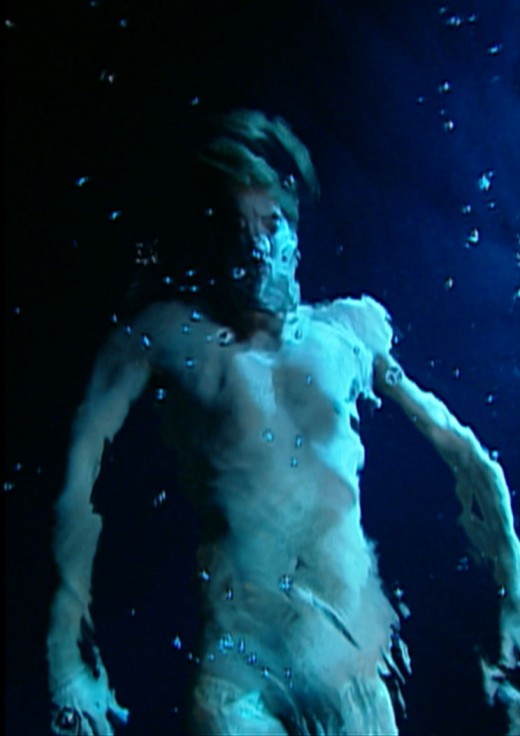
Pipilotti Rist
Meet the sensuous Swiss video artist Pipilotti Rist, whose work full of colour and playfulness. She here argues that videos can have painterly qualities and tells the story of one of her most famous videos, where a woman smashes car windows with a flower.
“There is no rule for when and where I get my ideas – some are survival tactics, some are psychotic tics, some are very well thought over.” The video ‘Ever is Over All’ (1997) was Rist’s response to a chief editor, who wouldn’t let her do the things she wished to do – even though he had given her a carte blanche. She felt like smashing his car, but instead chose to make a video, which challenged and even altered her aggression: “That was my catharsis.”
“I’m not more colourful than life is.” The screen is like “a moving glass painting” to Rist, who enjoys the playful use of colours. Moreover, she feels that a lot of people distance themselves from colour, even finding it intimidating. Rist, however, wants to fight for colour: “They call it superficial, but actually it’s dangerous.”
Elisabeth Charlotte “Pipilotti” Rist (b. 1962) is a Swiss visual artist, who works with video, film and moving images, which are often displayed as projections. She takes her name from Pippi Longstockings, heroine of Swedish author Astrid Lindgren’s much-loved series of children’s books. Early on in her career she began making super 8 films, which generally last only a few minutes and contain alterations in their colours, speed and sound. Among the themes her work centres on are gender, sexuality and the human body. In 1996 her work was first featured in the Venice Biennial, where she was awarded the ‘Premio 2000 Prize’. Other awards include the ‘Wolfgang Hahn Prize’ (1999), the ‘Joan Miró Prize’ (2009) and the ‘Cutting the Edge Award’ at the 27th Annual Miami International Film Festival (2010). Rist’s works are a part of prominent museums worldwide such as MoMA in New York City and Tate Modern in London.
For more about Pipilotti Rist see: http://pipilottirist.net/
Pipilotti Rist was interviewed by Christian Lund at the Hayward Gallery in London, November 2011.

Gravity Be My Friend

Pixel Forest

Mercy Garden
Stan Brakhage
Stan Brakhage, “Mothlight” (1963)
Stan Brakhage
American filmmaker who brought a unique eye to his craft
Ronald Bergan
Friday 14 March 2003 21.23 EST
Those who consider cinema a narrative art form, and believe that films should have a beginning, a middle and an end – in that order – will have problems with the work of Stan Brakhage, who has died aged 70. His films were difficult also for those not willing to shed the conventionalised illusion, imposed by rules of perspective, compositional logic and “lenses grounded to achieve 19th-century compositional perspective”.
For Brakhage, the goal of cinema was the liberation of the eye itself, the creation of an act of seeing, previously unimagined and undefined by conventions of representation, an eye as natural and unprejudiced as that of a cat, a bee or an infant. There were few filmmakers – film director is too limiting a description – who went so far to train audiences to see differently.
“Imagine an eye unruled by man-made laws of perspective,” he wrote in Metaphors On Vision, first published in the journal Film Culture in 1963, “an eye unprejudiced by compositional logic, an eye which does not respond to the name of everything but which must know each object encountered in life through an adventure of perception.
“How many colours are there in a field of grass to the crawling baby unaware of ‘green’? How many rainbows can light create for the untutored eye? Imagine a world alive with incomprehensible objects, and shimmering with an endless variety of movement and innumerable gradations of colour. Imagine a world before the ‘beginning was the word’.”
To a large extent, Brakhage realised this innocent world in his films, restrictively labelled avant-garde or experimental, existing in a parallel universe to the multiplex ethos. His signature was as figurative as it was literal – he would scratch his initials directly on the film’s emulsion at the end credits. Like a painter or sculptor, he worked manually on his material, often scratching, dyeing and altering the celluloid itself, making today’s push-button digital technology anathema to him.
He would hand-paint blank frames of 16mm film, and glue objects to them in a collage. In Mothlight (1963), for example, he pasted moth wings on to strips of film and, when projected, the bright light seemed to bring the insects back to life.
Brakhage was born Robert Sanders in a Kansas City orphanage, and adopted two weeks later by Ludwig and Clara Brakhage, who named him James Stanley. He performed on radio as a boy soprano, attended high school in Denver, Colorado, and, at 19, dropped out of Dartmouth College after two months to make films.
Among his early influences were Jean Cocteau and the Italian neo-realists but, after arriving in New York in 1954, he joined the flourishing avant-garde scene, drawing inspiration from artists and filmmakers like Maya Deren, Marie Menken and Joseph Cornell. He admired Ezra Pound, and was a close associate of poets like Kenneth Rexroth, Robert Creeley and Robert Duncan, and abstract expressionist painters such as Willem de Kooning, with whom much of his work has an affinity.
In 1957, he married Jane Collom, and the details of their lives together figured prominently in his work. In Window Water Baby Moving (1959), he unflinchingly and poetically documented the birth of the first of their five children.
In 23rd Psalm (1966), he contrasted scenes of his tranquil life in rural Colorado with footage of the second world war. The quick cuts of the first part, depicting a world menaced by chaos, give way to the contemplative passages of the second, suggestive of a quest for the roots of war – particularly the Vietnam war, then at its height.
Brakhage’s most famous film, Dog Star Man (1964), one of the key works of the 1960s American avant-garde, experimented with the use of colour, painting on film and distorting lenses, while depicting the creation of the universe. It ends with superimpositions of solar flares and chains of mountains over his wife, as she gives birth to their child.
During five decades, Brakhage made nearly 380 films, most of them shot in 8mm or 16mm, and ranging in length from nine seconds to four hours. With a few exceptions, they were made without sound, which he felt might spoil the intensity of the visual experience. He preferred to think of his films as metaphorical, abstract and highly subjective – a kind of poetry written with light.
Brakhage taught film history at the University of Colorado from 1981 until last year, when he retired to Canada with his second wife and two sons, who survive him along with the five children of his first mariage. It is a tragic irony that he seems to have been killed by the art he loved. According to his widow, doctors believed that the coal-tar dyes he used in his filmmaking may have contributed to his bladder cancer, which was diagnosed in 1996.
· James Stanley Brakhage, filmmaker, born January 14 1933; died March 9 2003
 Photography & Intermedia